
In this guide
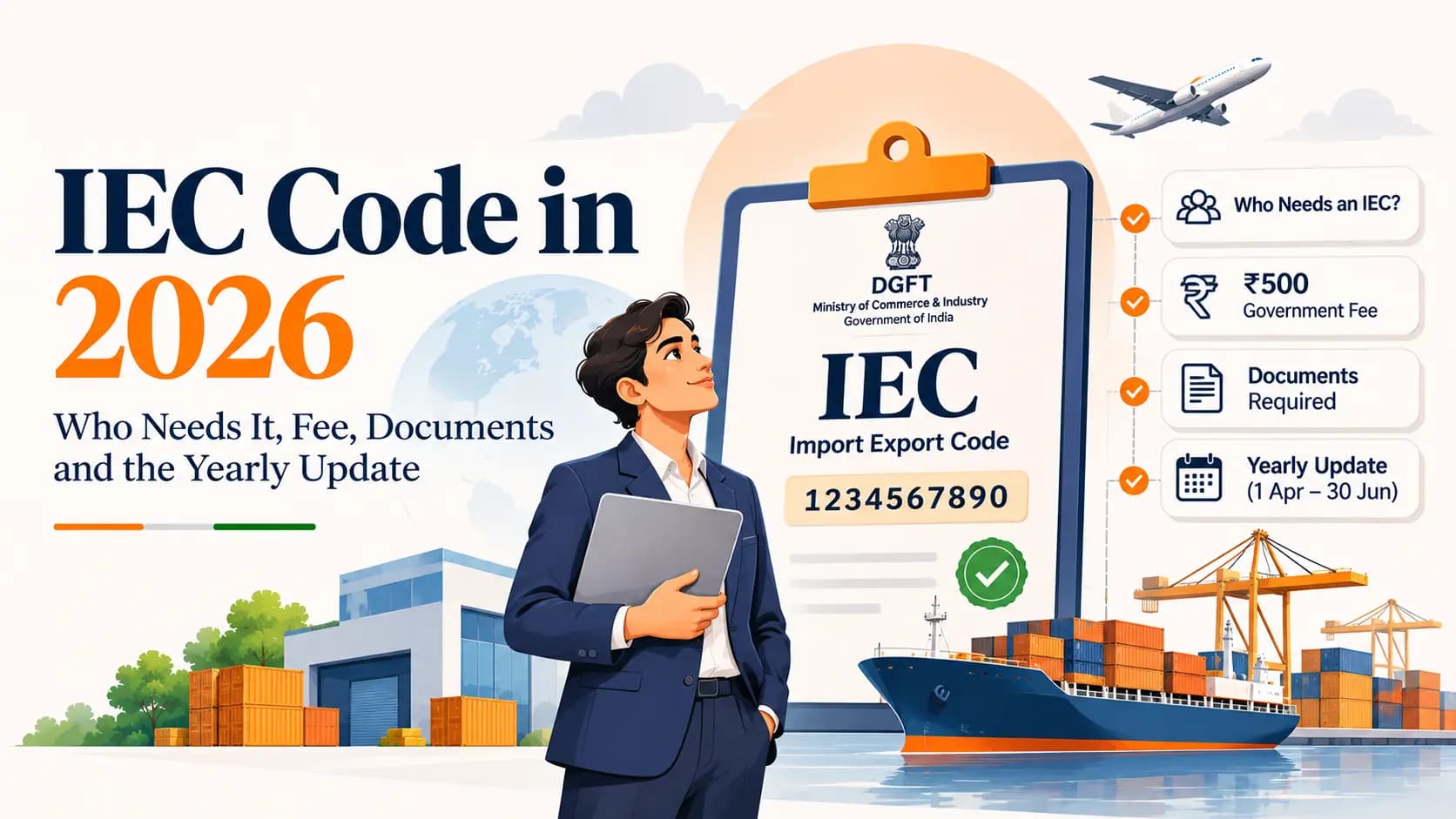
An Importer-Exporter Code (IEC) is a 10-digit PAN-based registration issued by the Directorate General of Foreign Trade (DGFT), and under Para 2.05 of the Foreign Trade Policy (FTP) 2023, businesses need it to import or export goods from India. The government application fee is ₹500, paid once.
While the code has permanent validity with no expiry date, Para 2.05(d) of the FTP requires every IEC holder to confirm or update their details electronically on the DGFT portal every year between 1 April and 30 June.
This guide is for small manufacturers, traders, service exporters and new exporters who want to go global without paperwork surprises. It explains who needs an IEC, what to prepare (including the February 2026 NPCI bank validation rule), how to apply and how to avoid deactivation. Facts are as of November 2026.
Who Needs an IEC?
Whether you need an Importer-Exporter Code depends on what your business does and whether you are importing or exporting goods, services or technology.
| Your situation | Do you need an IEC? | Rule under FTP 2023 & HBP |
|---|---|---|
| Importing goods for your business | Yes | Mandatory under Para 2.05(a) of FTP 2023 unless specifically exempt. |
| Exporting goods from your business | Yes | Mandatory under Para 2.05(a) of FTP 2023 to clear shipments on ICEGATE. |
| Importing or exporting goods for personal use | No | Exempt under Para 2.07(b) of HBP 2023 if not connected with trade, manufacture or agriculture. |
| Central or State Government ministries/departments | No | Covered under permanent exempt categories in Para 2.07 of HBP 2023 (using specified permanent IEC numbers). |
| Exporting services or technology | Only if claiming FTP benefits | Under Para 2.05(a) of FTP 2023, mandatory only when taking benefits under the Foreign Trade Policy (or if requested by your AD bank). |
Service exporters: the exact legal rule
Under Para 2.05(a) of the Foreign Trade Policy 2023, an IEC is not compulsory for service exporters (such as IT, SaaS, design, marketing or consulting firms) unless the service provider is taking benefits under the Foreign Trade Policy—in which case the IEC must be in place on the date of rendering the service.
Routine GST benefits like exporting services under a Letter of Undertaking (LUT) without paying IGST are governed by the IGST Act, not the FTP, so they do not legally require an IEC.
Does your bank or payment gateway ask for it?
Even when FTP 2023 does not mandate an IEC for routine service exports, some Authorised Dealer (AD) banks, cross-border payment gateways or overseas enterprise clients still ask for an IEC during KYC onboarding or when issuing e-FIRA / FIRC documents.
Because it costs ₹500 once, many service exporters obtain one to avoid banking friction—just remember that once you hold an IEC, you must complete the April–June annual confirmation every year.
What Documents Do You Need?
Keep these ready before you start your online application (Form ANF-2A):
Applicant and business documents checklist
- [ ] PAN card of the business entity (for a company, LLP, partnership or trust) or of the individual proprietor
- [ ] Identity and details of directors, partners or proprietor (matching PAN and MCA/deed records)
- [ ] Proof of business address: Sale deed, rent/lease agreement, or a recent utility bill (electricity, telephone, post-paid mobile or gas bill); plus the property owner's NOC if the premises are neither owned nor rented in the business's name
- [ ] Active bank account details, supported by a pre-printed cancelled cheque bearing the account holder's name or a bank certificate in the prescribed ANF-2A format
- [ ] Entity registration proof, such as a Certificate of Incorporation, Partnership Deed or Trust Deed, where applicable
- [ ] Active Class 3 Digital Signature Certificate (DSC) or Aadhaar e-Sign of the proprietor, partner or director for online authentication
Important: February 2026 bank validation rule
Under DGFT Trade Notice No. 23/2025-26 dated 6 February 2026, all active bank accounts linked to the PAN must be declared and are verified in real time via NPCI.
Under Para 2.05(b) of the Foreign Trade Policy 2023, only one IEC is issued against a single PAN, and the 10-digit IEC number is the same as your 10-character PAN. If your business operates multiple offices, factories or warehouses under the same PAN, you add them as branches inside your single IEC profile rather than applying for a second IEC.
If you need a digital signature, our guide on the Digital Signature Certificate (DSC) explains who needs one and how to get it.
How Do You Apply for an IEC?
The IEC application is submitted online through the DGFT portal using Form ANF-2A.
Register on the DGFT portal
Create an Importer/Exporter user profile at dgft.gov.in using a working email address and mobile number.
Start the Form ANF-2A application
Go to Services → IEC Profile Management → Apply for IEC and enter your PAN, entity constitution, branch addresses and active bank account details.
Upload your supporting documents
Attach your address proof and pre-printed cancelled cheque or bank certificate (PDF/JPEG within portal size limits). Make sure the business name, PAN and bank details match across CBDT, MCA, GST and NPCI records.
Pay the ₹500 application fee
Pay ₹500 (prescribed under Appendix 2K of the FTP/HBP) through the Bharatkosh / DGFT online payment gateway.
Sign and submit the application
Authenticate the form using your Class 3 Digital Signature Certificate (DSC) or Aadhaar OTP e-Sign.
Download your e-IEC certificate
Because the DGFT system auto-validates PAN with CBDT, company/LLP details with MCA, and bank accounts through NPCI, e-IEC generation is often same-day or within 1 to 2 working days when all records match cleanly.
How Does the Yearly IEC Update Work?
Under Para 2.05(d) of the Foreign Trade Policy 2023, every IEC holder must electronically update or confirm their IEC details on the DGFT portal every year between 1 April and 30 June, even if there are no changes and even if the business did no import or export during the year.
This is the part many businesses forget. Founders hear “lifetime validity” and assume there is nothing more to do. Add the 1 April–30 June window to your yearly compliance calendar now.
| DGFT IEC service / action | Government fee (Appendix 2K) | When it applies |
|---|---|---|
| New IEC application (Form ANF-2A) | ₹500 | One-time fee at initial registration. |
| Annual IEC confirmation (no changes in details) | ₹0 (Free) | Every year between 1 April and 30 June (or when confirming unchanged details to reactivate after 30 June). |
| IEC modification (changing address, bank, directors/partners or name) | ₹200 | When modifying details outside the April–June annual window or beyond 60 days of a change. |
What Happens If You Miss the 30 June Deadline?
Under Para 2.05(e) of the Foreign Trade Policy 2023, if an IEC is not updated by 30 June, it is automatically deactivated from 1 July.
Because the DGFT database syncs directly with the Customs ICEGATE portal, a deactivated IEC immediately blocks your Shipping Bills and Bills of Entry at customs, halts export incentive scrips (such as RoDTEP or Advance Authorisation), and can hold up trade remittances at your bank.
The window for 2026 closed on 30 June 2026—if you missed it, log in to dgft.gov.in now and check whether your status shows “Active” or “Deactivated”.
How reactivation works (and the ₹200 fee confusion explained)
DGFT does not levy a monetary late penalty for missing the 30 June deadline. To reactivate a deactivated IEC:
- Log in to dgft.gov.in.
- Go to Services → IEC Profile Management → Update/Modify IEC.
- Review your details and confirm your profile.
- Sign with your DSC or Aadhaar e-Sign.
If you are only confirming that your details are unchanged, DGFT charges ₹0. If you are modifying your address, bank account, partners or directors at the same time, the standard ₹200 modification fee under Appendix 2K applies.
Once submitted, the IEC status turns “Active” on DGFT immediately. Allow a few hours for the active status to propagate to the Customs ICEGATE mirror before filing a shipping bill.
What Comes After the IEC?
An IEC alone does not make your business ready to clear goods through customs. Depending on what you trade, plan for these five items:
- GST registration and Letter of Undertaking (LUT). Under Section 24 of the CGST Act, inter-state and export suppliers of goods generally require GST registration, and filing Form GST RFD-11 (LUT) lets you export without paying upfront IGST. See our GST and tax compliance services.
- Authorised Dealer (AD) Code and IFSC registration on ICEGATE. Exporters must obtain a 14-digit AD Code letter from the bank where they hold their current account and register it (along with their bank IFSC for IGST/drawback credits) on the Customs ICEGATE portal at the ports from which they ship. Without an active AD Code on ICEGATE, a shipping bill cannot be generated.
- Registration-Cum-Membership Certificate (RCMC). Issued via the DGFT common digital platform by the relevant Export Promotion Council (EPC), Commodity Board or FIEO. Under Para 2.55 of FTP 2023, an RCMC is mandatory if you want to claim benefits or concessions under the Foreign Trade Policy.
- Product-specific regulatory approvals. Depending on your product, you may need an FSSAI central licence (food products), CDSCO approval (drugs and medical devices), APEDA/MPEDA registration (agri/marine products), or Plant/Animal Quarantine clearance.
- Udyam registration. Helps eligible micro, small and medium enterprises access export credit schemes and MSME support. See our guide on Udyam registration.
Common Mistakes to Avoid
- Treating IEC as a once-only job. The April–June yearly confirmation is mandatory under Para 2.05(d) of FTP 2023, even if nothing has changed and even if you had zero shipments.
- Mismatched PAN, bank or MCA details. Since DGFT's February 2026 NPCI bank validation update (Trade Notice No. 23/2025-26), any mismatch between your PAN name and bank account name will block approval.
- Using an old email ID or mobile number. You may miss DGFT deactivation alerts or OTPs needed to log in.
- Not updating when your business constitution changes PAN. If a proprietorship converts into a Partnership, LLP or Private Limited Company, the PAN changes—you must surrender the old IEC and apply for a fresh IEC on the new PAN.
- Forgetting ICEGATE AD Code registration after getting the IEC. Having an IEC without registering your bank's 14-digit AD Code on ICEGATE will still block your first shipping bill.
- Paying well above ₹500 without asking what is included. The statutory government fee for a new IEC is ₹500. Consultants charge separately for document verification, DSC setup or AD Code/RCMC assistance, and that professional fee should always be stated transparently.
Frequently Asked Questions
What is the government fee for an IEC?
Under Appendix 2K of the Foreign Trade Policy, the DGFT application fee for a new IEC is ₹500, paid once online. Confirming unchanged details during the annual 1 April to 30 June window is free (₹0), while modifying details outside the annual window carries a ₹200 government fee. Any consultant service fee is separate.
Does an IEC expire?
No. An IEC has permanent validity unless cancelled or surrendered. However, you must electronically confirm or update your details on dgft.gov.in between 1 April and 30 June every year, failing which the IEC is deactivated from 1 July.
Can I export without an IEC?
For goods, an IEC is mandatory unless you fall under an exempt category in Para 2.07 of the Handbook of Procedures, such as importing or exporting goods for personal use not connected with trade, manufacture or agriculture, or specified government ministries. For services or technology, an IEC is mandatory only when you claim benefits under the Foreign Trade Policy, though some banks still ask for it during export-remittance KYC.
How do I reactivate a deactivated IEC?
Log in to dgft.gov.in, go to Services → IEC Profile Management → Update/Modify IEC, review and confirm your profile details, and authenticate using your DSC or Aadhaar e-Sign. There is no monetary penalty for late confirmation: ₹0 if no details have changed, or ₹200 if you modify details. The IEC reactivates on DGFT and syncs to ICEGATE within a few hours.
Can one business have more than one IEC?
No. Only one IEC can be issued against a single PAN. If your business has multiple factories, warehouses or offices under the same PAN, add them as branches inside your existing IEC profile on the DGFT portal.
Conclusion
Getting an IEC is fast and costs ₹500 in government fees when your PAN, address proof and bank account match cleanly. The real operational risk comes later, when a business forgets the April–June annual confirmation and discovers its IEC is deactivated on ICEGATE right when a shipment is ready to leave.
Apply with matching records, register your bank's AD Code on ICEGATE early, and put the 1 April to 30 June DGFT confirmation window on your compliance calendar every year.
Need help with your IEC registration?
Want help with your IEC application, AD Code registration or reactivating a deactivated code? AarambhGrow can help you organise the application and related export documentation. You can also contact us for a free consultation.
Sources & legal note
This article is general information as of November 2026, not legal or trade advice. DGFT rules can change. Check the latest notices at dgft.gov.in before you apply.
- Directorate General of Foreign Trade (DGFT) Official Portal
- DGFT Foreign Trade Policy (FTP) 2023 – Chapter 2, Para 2.05 and Para 2.55
- DGFT Handbook of Procedures (HBP) 2023 – Chapter 2, Para 2.05 to 2.07 and Appendix 2K
- DGFT Trade Notice No. 23/2025-26 (dated 6 February 2026) – Mandatory declaration of active bank accounts and NPCI validation in IEC profile
- Indian Customs Electronic Gateway (ICEGATE) – AD Code and IEC status verification